Meet the local groups we have partnered with
Three Villages Flood Group
Three Villages Flood Group is a community-led group supporting the villages of Mudford, Ashington and Chilton Cantelo. It was formed after local residents and Mudford Parish Council raised concerns about increasing flooding across the parish and surrounding areas.
Flooding has affected local roads, homes, residents and businesses, with West Mudford Road becoming impassable on several occasions. The group aims to raise awareness of flood risk and take practical action wherever possible to reduce the threat and impact of flooding within the three villages.
Its activities include supporting local flood wardens, encouraging residents to help keep drains clear, assisting vulnerable members of the community during severe weather and improving local emergency preparedness. The group also works with residents, councils and partner organisations to explore local solutions and strengthen community flood resilience.
Yeo Rivers Community Trust is pleased to work alongside Three Villages Flood Group to support projects that help protect local communities and improve the health and resilience of the surrounding landscape and waterways.
Cam Catchment Resilience Project (CCRP)
Introducing the Cam Catchment Resilience Project (CCRP) Working together to build a more resilient landscape for people, wildlife and water
The Cam Catchment Resilience Project (CCRP) brings together local people, landowners and partner organisations to deliver a coordinated, whole-catchment approach.
Its aims are to reduce flood risk, improve water quality and increase biodiversity through the use of nature-based solutions (NbS), with a strong emphasis on local knowledge and site-specific assessment.
The project offers support and guidance across a wide range of relevant topics. These include technical support on flood and drought management, environmental and ecological issues, adapting to the impact of climate change, and monitoring water quality. CCRP can also assist with identifying and accessing funding opportunities, understanding riparian ownership responsibilities, securing consents and permissions, and achieving enhanced compliance with regulations.
A key focus of CCRP is to support stakeholders by encouraging the sharing of information, experience and innovation through a variety of channels, helping to build a well-connected and informed local network.
CCRP is coordinated by the Yeo Rivers Community Trust (YRCT), which provides friendly networking opportunities for local landowners and interested parties. YRCT works closely with other organisations, including the Farming and Wildlife Advisory Group (South West), Wessex Water, the Environment Agency, Somerset Rivers Authority, Somerset Wildlife Trust and the Westcountry Rivers Trust.
This broad collaboration draws on extensive expertise, enabling YRCT to design and deliver a range of interventions which are acceptable to stakeholders and which provide multiple benefits to mitigate environmental impacts, build resilience and promote environmental and economic sustainability. YRCT is also a member of the Somerset Catchment Partnership.
In March 2026, YRCT completed work on 21 substantial leaky woody dams in Galhampton, marking the beginning of a wider rollout of practical NbS across the catchment.
YRCT is in the process of sourcing funding for a range of interventions, including leaky dams, flow pathway barriers, floodplain reconnection, tree hinging and wetland habitat creation for landowners who are willing to implement such measures. For more information, please email: info@YRCT.org.uk

Wriggle River Improvement Group (WRIG)
WRIG is an association of local people, landowners, and organisations working together to improve the Wriggle River. The group was set up in May 2023 and aims to address issues of flooding, water quality, and waste along the riverbanks, within the Wriggle River catchment and offer friendly networking and advice for local landowners and interested parties. We have representatives from local parish councils (Chetnole, Leigh, Yetminster) as well as the High Stoy Conservation Cluster, Hilfield Friary, the Leigh Climate Group, Dorset Council, the Farming and Wildlife Advisory Group South West and the Yeo Rivers Community Trust.
The broad range of organisations and expertise within the group enables it to provide advice and guidance on diverse topics which are most relevant to stakeholders. Topics include technical advice on flood/drought management and environmental/ecological issues, adapting to the impacts of climate breakdown, monitoring water quality, identifying and accessing funding opportunities, riparian ownership responsibilities, securing consents and permissions and achieving enhanced compliance with regulations. The emphasis is on supporting stakeholders and a key function of the WRIG is to facilitate the sharing of information, experience and innovation among stakeholders through a variety of channels.
One of the group’s first activities is to initiate a Citizen Science water quality monitoring initiative which will focus on measuring phosphate levels across the Wriggle Catchment. The scientific data obtained will be incredibly helpful for all stakeholders as a basis for designing effective management interventions.


Yeo Rivers Community Trust is acting as a representative for WRIG and is also seeking significant funding for implementing Natural Flood Management interventions across the Wriggle and neighbouring Beer Hackett Stream Catchments. If successful, this will provide funding for a range of interventions, including leaky dams, flow pathway barriers, flood plain reconnection, tree hinging and wetland habitat creation between 2024 and 2027 for landowners who are willing to accept such measures.
A map detailing the Natural Flood Management features installed by YRCT, working in partnership with the WRIG and local landowners can be viewed here:
https://www.google.com/maps/d/u/0/embed?mid=1q8bquVD5am9VOp0inaa9L4VFUEAMTV0&ehbc=2E312F
WRIG has a regular column in the Wriggle Valley Magazine providing information and updates about what we are doing, including local engagement activities, stakeholder meetings and events and important news items relevant to stakeholders generally.
For more in depth information about the WRIGs work see article archive here:
If you would like to learn more about the group and find out how to join WRIG, all queries can be emailed to info@yrct.org.uk in the first instance.
Nature Watch Group
The Nature Watch Group was born out of the desire to protect and support the nature that is on our doorstep, in the Queen Thorne parish. Where national policy fails, small steps and local action can really make a difference. Kindness is at the heart of our ethos; towards each other and towards nature.
Initiation of the group was prompted by local residents noticing a sharp decline in wildlife. Our first action was a door knocking exercise. We walked from door to door and asked people if they had concerns. Many residents of the village had noticed a loss of aquatic life in the streams, a loss of amphibians and a decline in the volume and duration of the spring dawn chorus. Residents also shared concerns about badger culling, hunting with hounds, agro-chemical contamination, and destruction of breeding birds nests. Several villagers had independently approached relevant statutory bodies and were unhappy with the lack of action, which led some residents to begin taking matters into their own hands.
In the parish of Queen Thorne, the obvious place to start was with the streams. We are in an unusual situation as all of our waterways originate here… we can’t blame anybody else for our pollution, and our pollution becomes everybody else’s pollution.
We realised that, if we found there was a problem, we needed evidence which could not be disputed, so we have initiated a combination approach to water testing. Free training was made available for members of the group, with a view to fortnightly data collection during the summer.
We secured a piece of water testing equipment, allowing us to take scientific measurements of chosen pollutants in water courses. We opted for phosphate, nitrate and ammonia tests, in order to establish a baseline. When the same tests were run in November 2022, following heavy rain, we found the levels of phosphates had risen - in one case to 10 times the accepted ‘safe’ amount, which a local expert hydro-ecologist described as "catastrophic". The hope is that identifying any problems beyond doubt will prompt a resolution to take action.
As a group, we are in our fledgling stages, but we are making good progress. We have found the advice and support of other existing groups invaluable. We are working side by side with a number of established environmental charities, and are grateful to benefit from their experience.
There appears to be a will to halt and reverse biodiversity loss among the majority of people, but the seriousness of the situation is often found so overwhelming that many don’t know where to start. What is certain is that a group has more influence than an individual.
Yeo Rivers Community Trust supported The Nature Watch Group in gaining their charitable status and continue to provide ongoing support where we can. Visit The Nature Watch Group website to learn more about the group and how to become a member.
Mudford Withy Bed Project
YRCT are working with Mudford Parish Council and local residents to revitalise the neglected withy bed. The aim is to involve the community, with a focus on children and young people from the village and surrounding area, creating a new publicly accessible green space whilst protecting and improving the habitat for flora and fauna.
The Withy Bed is a small triangle of land next to Mudford Bridge owned by the Mudford Parish Council.
Traditionally, a withy bed is a place where willow withies, thin rod of willow, are harvested. These willow rods can be used for lots of different purposes, from basket making, fish traps, hurdles and bank erosion control to name just some. Willows grow very fast so the rods that grow off the main stump can be harvested every year, leaving the stump or stool to grow another harvest the next year. Overtime the stumps become large bulbous and twist into fantastic shapes and become rich homes of mosses, lichens and insects. The Mudford Withy Bed currently has one intact withy.

Able2achieve
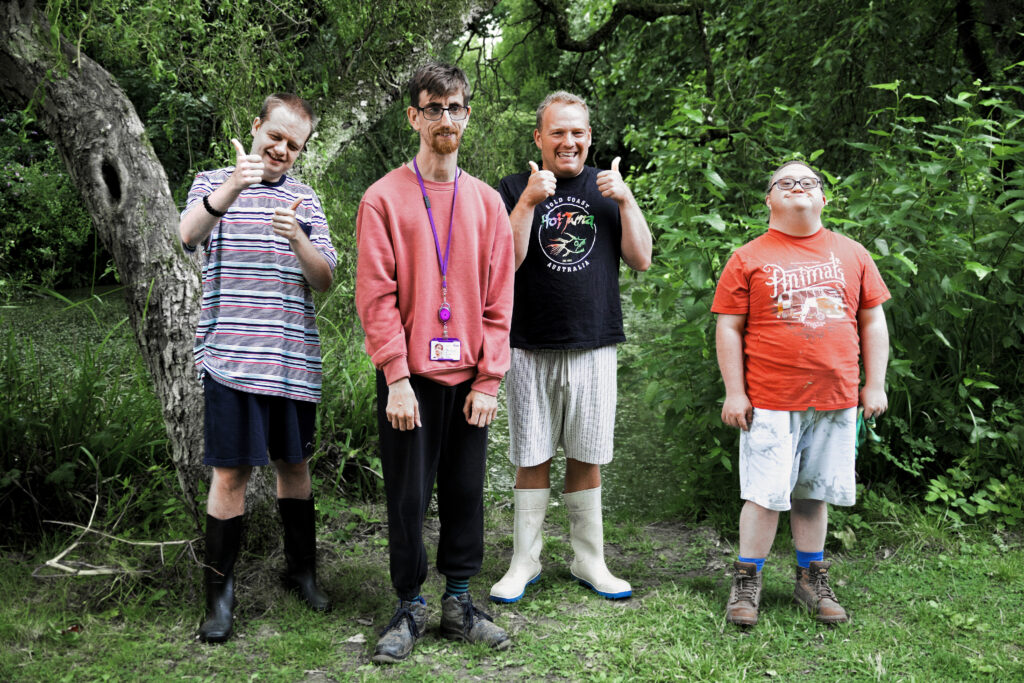
The learners from Able2achieve regularly volunteer to help us on practical conservation workdays and ecological surveys
https://www.able2achieve.org.uk/index.html